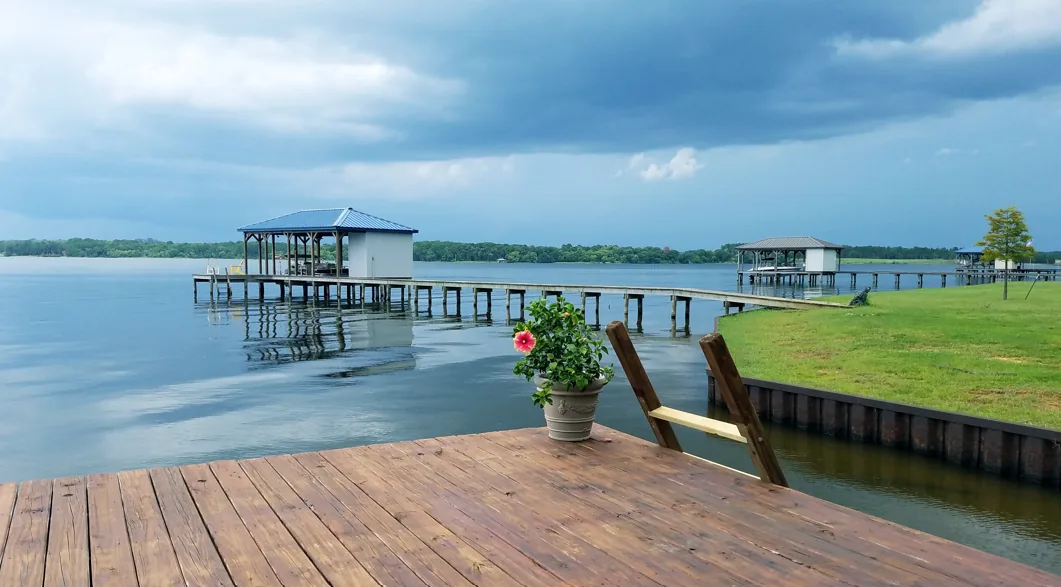
The part almost every buyer gets wrong
If you're looking at waterfront on Lake Palestine, here's the thing to understand before you fall in love with a view. Lake Palestine dock permits all start from one fact most buyers don't know.
You probably don't own the land down to the water.
Lake Palestine sits at a normal pool elevation of 345.0 feet above mean sea level. The 100-year flood elevation is 355.0 feet. That strip of ground in between, the part with your dock on it and the part you'd walk across to get to your boat, is owned outright by the Upper Neches River Municipal Water Authority. In the few cases where it isn't owned outright, the Authority holds a flood easement over it instead.
Either way, UNRMWA's own building guidelines are blunt about what that means: use of that property is "prohibited except by permit(s) granted by the Authority."
So the lot line on the plat and the water's edge are two different things, and the ground between them comes with a landlord. That isn't a problem. Thousands of people on this lake have docks and boathouses and get along with the Authority just fine. But it's a fact worth knowing before you write an offer, not after.
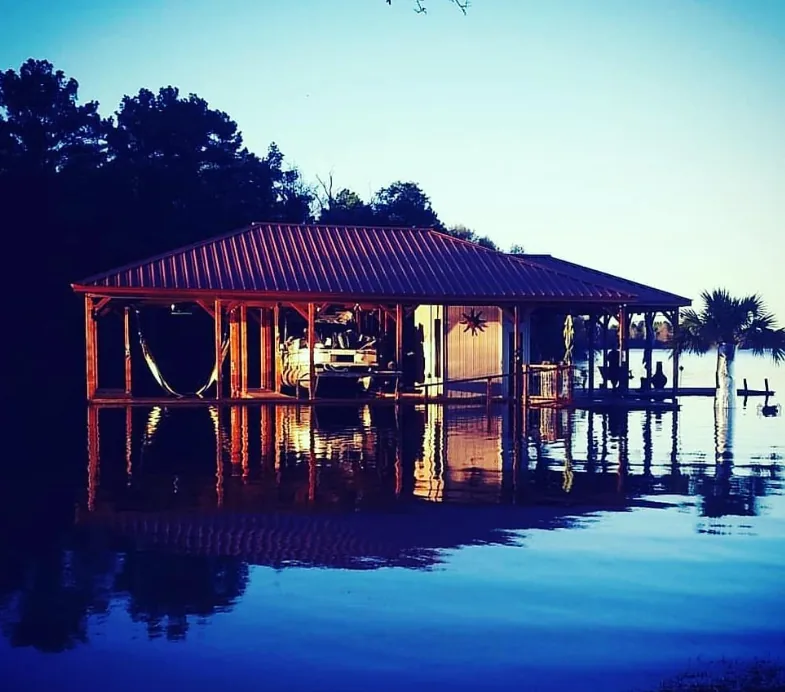
Looking at a place on the water?
Before you write an offer, I'll help you figure out what's permitted, what the dock needs, and what questions to ask while you still have room to negotiate.
What it costs
Here's what UNRMWA publishes, as of September 2026. You can check every figure yourself on the Authority's Rules and Regulations page, which carries the full fee schedule.
The Limited Use Permit is $25 a year per lot, plus 5 cents for every foot of frontage. The frontage is measured along the 355-foot line, not at the water. So a lot with 200 feet along that line comes to $35 a year. (UNRMWA fee schedule)
That "per lot" matters more than it sounds. It's charged per lot, not per owner, so if you buy three lots side by side, you pay the $25 three times.
A construction permit is $50 per application, and it's good for 180 calendar days. If the work isn't finished by then, the permit is void, and you'll need a new application and a new fee to keep going. Change the design in a significant way after the permit's issued and that's an amendment, which is another $50. If an inspection has to be redone, the reinspection costs half the permit fee. (Fee schedule and 180-day rule; amendment fee, building guidelines)
None of these numbers are new. The $50 fee is printed on the Authority's permit application, revised in 2017. And when UNRMWA reissued its building guidelines in October 2023, every fee in them stayed exactly where it was.
Here's the thing, though. The fees are the small part. The bigger cost is the survey the inspection requires, and that's coming up in a minute.
Two permits, and the order matters
There are two separate permits, and buyers routinely assume there's one.
The Limited Use Permit (LUP) is the annual permit that gives you, in the Authority's words, "any permissive rights whatsoever" on the ground between the takeline and the lake surface. It's what makes your use of that strip legitimate at all. It renews annually.
The Permit to Install and Construct Facilities is the separate, per-application permit you need before building a pier, boathouse, boat ramp, bulkhead, dock, or really any structure on Authority property. It's also required before you excavate or place fill below 355.0 feet.
Here's the ordering trap, straight from the guidelines:
No construction permit will be issued without a current LUP.
If you're buying a property where the seller let the LUP lapse, or where an existing dock was built by someone who never held one, that's a thing to sort out during the option period, not after closing. It's usually fixable. It's much easier to fix while you still have leverage.
One more that surprises people: failure to keep a boathouse, pier or other structure on Authority property "in a safe and usable condition" can get the LUP revoked. A neglected dock isn't just a repair bill. It's a permit risk. It shows up in the price, too, and I explain how docks, depth and shoreline move value in what really determines a Lake Palestine home's value.
The inspection nobody mentions
This is the part that isn't in anybody else's write-up, and it's the one that costs real money.
The construction permit application says that before the permit is issued, there's a pre-permit inspection, and:
"All necessary property corners with minimum of outside corners at roadway and at waterfront
take line (elevation 355') must be clearly marked at time of pre-permit inspection."
Read that again. Your property corners have to be physically staked before the Authority comes out. Not just the ones up by the road. The ones down at the 355-foot take line too.
In practice, for most buyers, that means hiring a surveyor. That's a cost and a calendar delay that appears nowhere in the permit fee, and if you're budgeting off the fee schedule alone you'll be caught out by it.
We went through this on our own lot. We had it surveyed, and we had the surveyor find the 355 line too, so we'd know exactly where we could build and where we couldn't. Then we paid extra to have it marked all the way down to the water.
The application also has office-use checkboxes for confirming the LUP is current and for "field inspection completed and recommended for approval," so this is the normal process, not an exception someone hit once.
Two other things the application asks for that are worth lining up early: a named contractor with a phone number, and a plat showing your shore-front dimensions along with scaled drawings showing front, rear and side elevations.
What you're allowed to build
The dimensional rules in the building guidelines are more specific than most people expect. These are the ones that come up most often:
- 70 feet. No structure may extend more than 70 linear feet from the shoreline at normal pool (345.0'), measured perpendicular to the shore, except by variance. If you need more water depth than that gets you, that's a conversation to have before you buy, not after.
- 10 feet from the neighbor's line. No structure may come within 10 linear feet of an adjacent property line extended out from the 355.0' takeline. See the next section, because coves work differently.
- Channels. No structure may occupy more than a third of any channel width, and no part of it may come within 10 feet of the channel centerline.
- Lighting. Anything extending past 70 feet has to have adequate continuous lighting.
- Boathouse slips. Non-commercial boathouses are limited to two wetslips plus one personal watercraft slip, unless there's a justifiable need and room without a variance. Additional stalls have to be open structure.
- Covered areas. A covered sitting area can't exceed 400 square feet. A storage closet can't exceed 144 square feet. A deck or landing at the end of a pier can't exceed 256 square feet, and an elevated deck can't have anything on it but guardrails.
- No plumbing. At all. No living quarters, kitchens, toilets, or anything with plumbing fixtures on Authority property, whether it's "spanned, cantilevered or by other means." No overnight residency.
- Swimming pools have to be located above the 355.0' elevation.
And a general note that's easy to miss: the Authority reserves discretion where the guidelines "may not be practicable," and on construction permits, "the decision of the General Manager shall be final." That's not a warning. It's a reason to talk to them early rather than build first and ask later.
Coves work differently
If you're comparing a cove lot to open water, the spacing rule is one of the real differences, and it's written right into the guidance.
The 10-foot lateral setback from the neighboring property line comes with an explicit carve-out:
"NOTE: This rule may not apply to waterfront lots located in coves. In such cases, the Authority
shall allocate spacing for structures on the water in an effort to protect access to the lake
for those owning waterfront lots or acreage."
So in a cove, the Authority allocates the spacing rather than applying a fixed setback. The stated purpose is protecting everyone's access to the water, which in a tight cove is a genuinely finite thing.
What that means practically: in a cove, what you can build depends partly on what your neighbors already built. Two lots with identical frontage can end up with different answers. If a cove lot is on your list and a dock matters to you, that's a question for the Authority before the option period runs out.
If you're weighing a cove lot against open water, the tradeoffs go well beyond spacing. I walk through them in Lake Palestine cove vs open water.
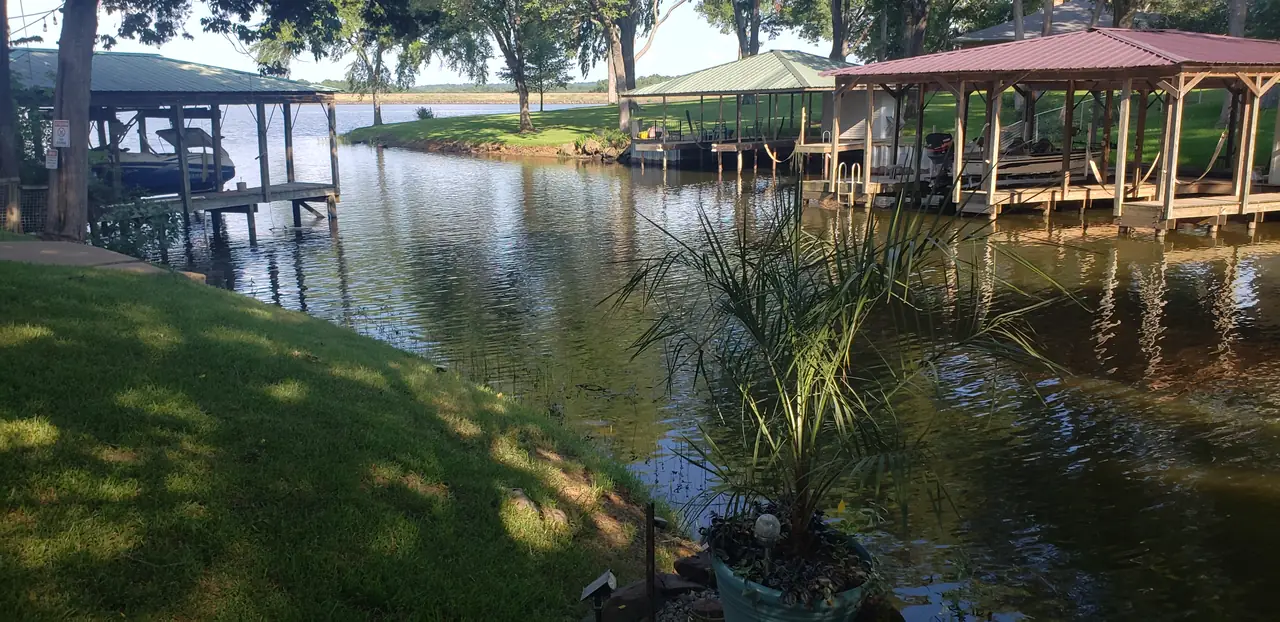
Buying a place that already has a dock
Most buyers aren't building from scratch. They're inheriting whatever the last owner put in. Here is what to actually look at.
Floating docks are rare here. Most residential docks on Lake Palestine are stationary. I only know of one floating dock in a residential area, and I'd only consider one where the water's deep enough to handle the lake's fluctuation. In a shallower part of the lake, I absolutely wouldn't put one in.
If the dock you're looking at does float, the flotation rules are strict. Metal barrels are prohibited outright. The only approved flotation is extruded closed-cell or foam-bead polystyrene encased in an approved protective cover, and any replacement flotation on an existing structure has to use the approved encapsulated type. Bare white foam crumbling into the water isn't just ugly. It's out of compliance, and it's now your problem.
Materials. Anything exposed to the weather is supposed to be cedar, redwood, treated wood, concrete or steel.
Bulkheads and retaining walls. No creosote. Sheet piling has to be minimum 8-gauge steel or PVC. The wall can't sit below the 345.0' elevation as shown on the plat of record, and it can't go above it without the Authority's approval.
Permit history. Ask the seller for the LUP and the construction permits. Repair that doesn't change the "footprint" of an existing permitted structure generally doesn't need a permit, but anything that changes the footprint does. A dock that quietly grew over the years may not match what was permitted.
What I look at when I walk a dock with a buyer
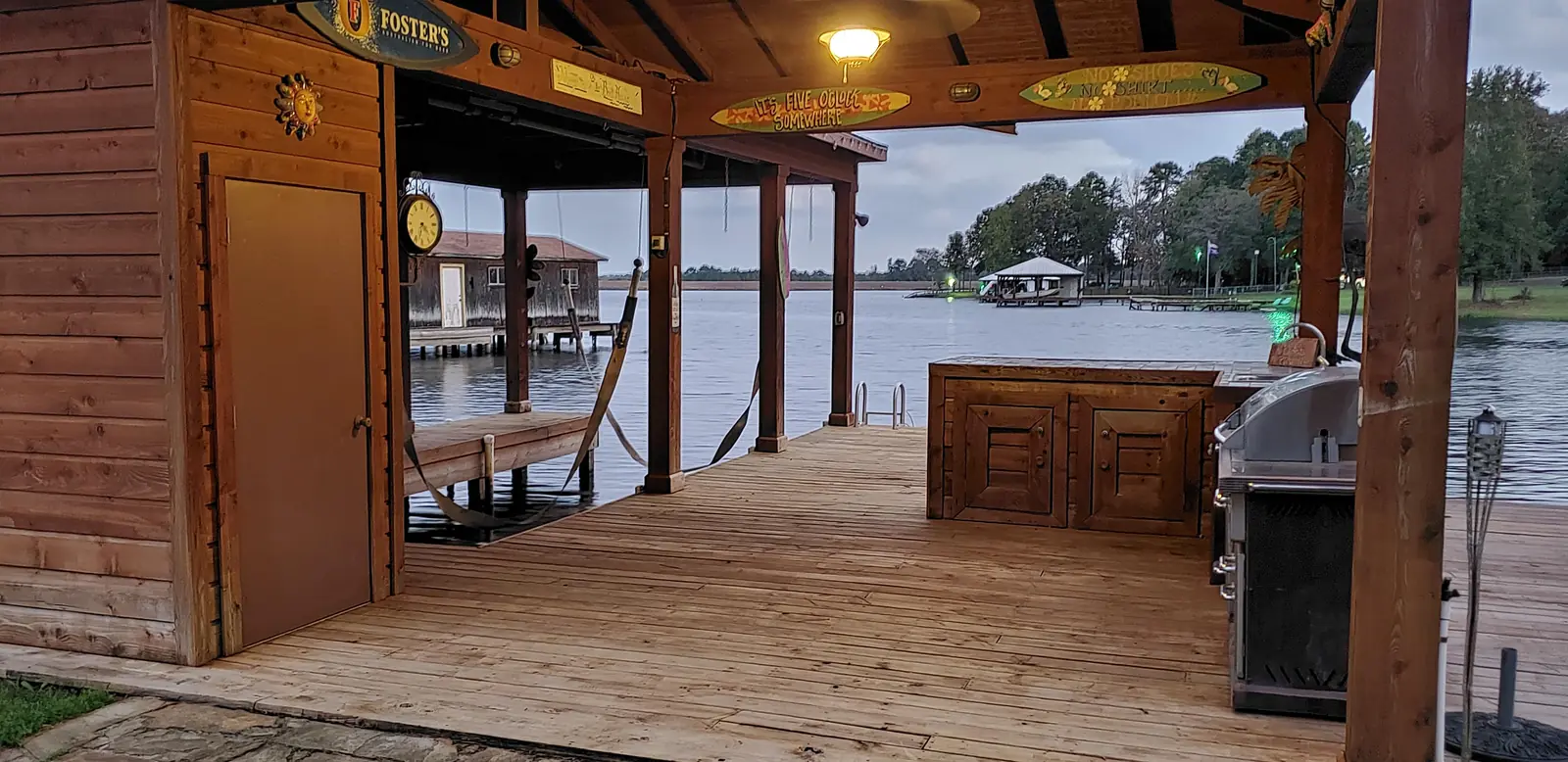
When I walk a dock with a buyer, the first thing I notice isn't the dock. It's what leads to it. Is there a bulkhead, or does the bank just run straight down into the water? That tells me what the dock is attached to. With a good bulkhead, it's fastened to something solid. Without one, water can wash out the bank at the end of it.
Then I look at how stable it is, and at the boards. Are they in good condition, or do they need repair?
I also want to know whether it's being used. A dock somebody's out on every weekend looks different from one that's been sitting for years.
I check the boat lift, too. Pontoons and runabouts usually sit on a strap lift, so I look at how the straps are holding up. Wake boats, like a Nautique or a Malibu, need a different kind of lift, usually a cradle lift, because of how the transom and motor are built. That's worth knowing if you're bringing one.
After that, it's what's been run to it. Is there electricity? Water? A fish cleaning station?
And if we can tell how deep the water is where the boat would sit, that helps too.
As for what repairs cost, whether it's a bulkhead (some folks call it a seawall) or new decking, it really depends on which company you call and where they're coming from. So I won't throw out a number that won't hold up. What I can do is put you in touch. I have resources for that kind of work, and if you're looking at a place and want someone to come out and take a look, I'm glad to help set that up.
Getting the dock inspected
Your home inspector can look at the boathouse too, if you ask them to add it to the inspection. They'll check the electrical and a few other things, but it isn't as deep a look as they give the house. If something about stability or anything else worries you after that, you can call a boathouse builder or a dock repair company to take a closer look.
How deep you go is really up to you. Some buyers want the basics and some want every board checked, and there are plenty of options either way.
Surveys come up again at closing, too. If you want the fuller picture, see the survey mistakes East Texas buyers make and whether you need a survey to sell.
Living with the rules: mooring, houseboats and the 48-hour rule
These come from UNRMWA's Rules and Regulations, which is a separate document from the construction guidance. Worth knowing if you plan to keep a boat.
- No watercraft may be used as a residence. Full stop.
- No permanent anchoring on the reservoir, and "no open moorings whatsoever will be allowed on Lake Palestine." A boat not in use has to be removed from the lake, or moored or stored at an authorized commercial dock, pier or boathouse, or at a privately owned permitted facility.
- The 48-hour rule. "All craft left unattended on the Lake for more than 48 hours shall be considered to be abandoned property." Separately, personal property left unattended beyond 48 hours may be impounded, and if it isn't reclaimed within 90 days it can be sold, destroyed, or otherwise disposed of.
- Big boats. Watercraft over 40 feet long or 14 feet wide need a special permit, unless they're only present for eight hours or less.
- Cabin craft with toilets must have a holding tank and pump-out capability.
- Skiing isn't allowed within 400 feet of the shoreline except for launching and landing.
A couple of others that catch owners off guard:
- Trees. Trees and brush under 3 inches in diameter can be cleared by hand for the view without a permit. Mechanical clearing that disturbs the topsoil needs one. And any timber on Authority property belongs to the Authority, including the money if it's sold.
- Fences. Permit required, 48 inches maximum height, open mesh or split rail only, and never below 345.0'.
- Dredging. Every bit of dredging in Lake Palestine needs an Authority permit, even where the Army Corps of Engineers doesn't require one.
- Septic. Any on-site sewage system within 525 feet of the takeline has to be permitted by UNRMWA, and no sewage facilities can be built below the takeline at all.
Who to talk to
UNRMWA's office is at Blackburn Crossing Dam on FM 1892 near Frankston. Phone is 903-876-2237, and mail goes to P.O. Box 1965, Palestine, TX 75802.
For anything to do with a construction permit, the call goes to the General Manager. The Authority's own rules make the General Manager's decision on those final, so if a question could affect a purchase, that's the office to ask, and it's worth asking before the option period runs out.
They also publish a list of building contractors who work on piers, boathouses and retaining walls around the lake. It's worth knowing that list exists, because it isn't linked from anywhere obvious on their site.
The honest summary
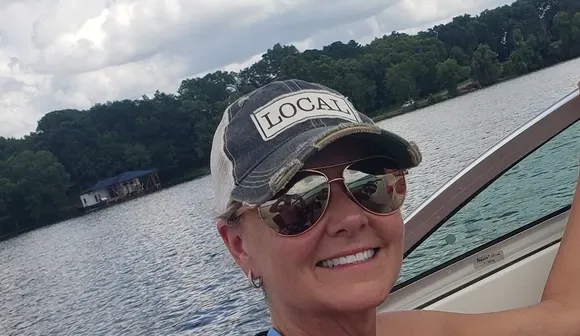
Waterfront on Lake Palestine is worth it. But the ground your dock sits on isn't quite yours, the permits come in a specific order, and there's a survey hiding behind the inspection that nobody puts in the brochure.
None of that should scare anybody off. It's all workable, and the Authority isn't difficult to deal with. It just needs to be worked out during the option period, while you still have room to negotiate, rather than discovered in your second summer.
Coming In From Out of Town to Look?
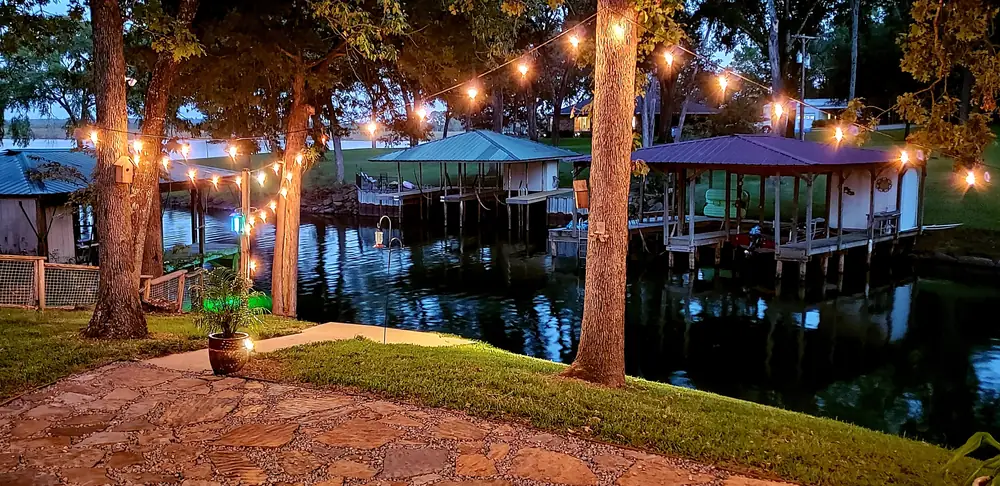
A lot of my buyers drive in from Dallas or Houston to spend a weekend getting a feel for the lake before they decide on anything. If that's you, my husband and I also own a vacation rental on Lake Palestine, and you're welcome to book it while you tour homes. It's a good way to see what living with a dock and a boathouse is really like before you buy one. Text or call me at 903-724-2338 and I'll help you set it up.
Lake Palestine Dock Permit FAQ
Do you own the land down to the water on Lake Palestine?
Usually not. The strip between normal pool at 345.0 feet and the 355.0-foot takeline is owned by the Upper Neches River Municipal Water Authority, or covered by its flood easement, and using it takes a permit.
Source: UNRMWA building guidelines
How much is a Limited Use Permit on Lake Palestine?
$25 a year per lot, plus 5 cents for every foot of frontage along the 355-foot line. That's UNRMWA's published fee schedule as of September 2026.
Source: UNRMWA fee schedule
Do I need a permit to build a dock on Lake Palestine?
Yes. Building a pier, boathouse, bulkhead, dock or boat ramp takes a construction permit from UNRMWA. It's $50, good for 180 days, and it won't be issued without a current Limited Use Permit. Repairs that don't change the structure's footprint generally don't need one.
Source: UNRMWA rules and fee schedule
Do I need a survey to get a dock permit?
In most cases, yes. Your property corners, including the ones at the 355-foot takeline, have to be clearly marked before UNRMWA's pre-permit inspection, and for most owners that means hiring a surveyor.
Source: UNRMWA permit application
How far can a dock extend into Lake Palestine?
No more than 70 feet from the shoreline at normal pool, measured straight out from the shore, unless UNRMWA grants a variance.
Source: UNRMWA building guidelines
Can I get a dock inspected before I buy?
Yes. Your home inspector can add the boathouse to the inspection, though it won't be as deep a look as the house gets. For a closer look at stability, call a boathouse builder or a dock repair company.
Who do I call about dock permits on Lake Palestine?
The Upper Neches River Municipal Water Authority, at 903-876-2237. Their office is at Blackburn Crossing Dam on FM 1892 near Frankston.
Source: UNRMWA contact page
Buying on the Water? Let's Talk It Through
Docks, permits and shorelines are where waterfront deals get complicated, and they're a lot easier to sort out before closing than after.
Tell me about the property or the dock you're looking at. I'll help you figure out what to check, who to call, and what it means for your offer. I have resources for dock and bulkhead work if you want someone to come take a look.
Still early in your search? Fill out my buyer questionnaire and I'll know what you're looking for before we talk.
Or reach me directly: 903-724-2338 (call or text) · [email protected]
Charlene Hall, GRI, Your East TX REALTOR®
About Charlene Hall · Lake Palestine Real Estate Agent
Brokered By: Palestine Realty
"Selling Real Estate with Heart"